
Robert Donnelly
Global Client Executive Leader

Imagine you’re cruising down an open highway with the wind flowing through your hair on a warm summer day, with your favorite playlist keeping you company. Beneath this smooth ride, however, is a complex layer of protection—car insurance. Car insurance is often viewed as just a requirement to enjoy your nice ride. Once you purchase it, you likely put it away and hope you never need it. But with rising repair costs, increasingly severe weather, and evolving vehicle technology, auto insurance plays an important role in protecting long-term financial security.
In February, National Car Insurance Day is a good time to shift gears and dive into the rising costs, evolving technology, and environmental risks that are rewriting the rules of the road and your insurance coverage.

Vehicles today are heavier, more technologically advanced, and significantly more expensive to repair than they were just a few years ago. You can think of your car as a high-tech computer on wheels—packed with sensors and cameras that can turn a minor fender-bender into a costly calibration conundrum. Advanced driver-assistance systems are reducing crashes and improving safety, but even minor accidents often result in higher repair costs due to sensors, cameras, and calibration requirements.
Meanwhile, the price tag on protection is accelerating. Car insurance costs have risen 55% on average in recent years, reflecting higher claims severity, medical expenses, and replacement costs. These pressures affect all drivers, regardless of their driving record.
Think of your car insurance policy as a multi-layered shield—each layer designed to fend off different financial risks on the road. Most policies include:
Where you park your car can be just as important as how you drive it. Auto insurance is increasingly shaped by geography. Insurers assess risk not only based on driving history but also on where vehicles are garaged and operated.
Across the country, regional trends are driving differences in premiums:
Coastal and hurricane-exposed states face higher comprehensive losses tied to flooding and storm surge.
Hail-prone regions, particularly across the Midwest and Plains, continue to see elevated claims from severe convective storms.
Wildfire-impacted areas experience total vehicle losses and smoke damage, even when flames never reach roadways or driveways.
Dense urban areas are seeing increased liability losses driven by traffic congestion and higher medical and legal costs.
Our team explored regional insurance patterns in greater detail through the 2026 Insurance Insights report, which includes detailed analyses of auto insurance trends across the Northeast, South, Midwest, Mountain West, Texas, Florida, and Pacific regions. These regional trends help drivers see how national trends translate into local insurance outcomes.
 Auto insurance rates for California residents.
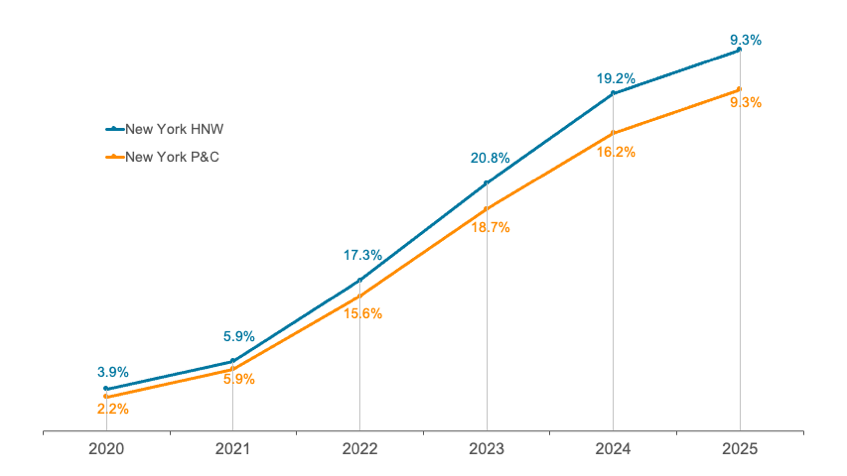 Auto insurance rates for New York state residents.
Tens of thousands of cars are damaged every year by floodwater. Unlike homeowners’ insurance, flood coverage for vehicles is not an add-on. Protection comes through comprehensive auto insurance. When vehicles are exposed to floodwaters, damage can occur beyond the visible parts of your vehicle. Modern vehicles rely on extensive electrical systems, sensors, and onboard computers that can fail in a flood event. Even minimal flooding may result in long-term mechanical and safety issues, leading insurers to declare vehicles a total loss.
Flooding creates additional risks for electric vehicles, particularly when saltwater is involved. Saltwater is highly corrosive and can compromise lithium-ion battery-powered systems, increasing the risk of thermal runaway and ignition.
Public warnings issued by Florida authorities following Hurricane Helene in 2024 urged EV owners to take additional steps to protect lives and property after flooding events. Local emergency responders reported nearly a dozen fires caused by EVs and their lithium-ion batteries igniting, highlighting the potential hazards these vehicles pose to others after flood events.
While insurance plays a critical role after a loss, mitigation may help reduce damage—or prevent it altogether. Our Private Client Services (PCS) insurance advisors emphasize the importance of planning well before severe weather is on the radar. Some mitigation strategies to consider include:
Car insurance is an evolving safeguard that is shaped by technology, climate, and regional risk. Understanding how coverage works, how losses occur, and how mitigation may help reduce exposure allows drivers to make more informed decisions long before a claim is filed.
At MMA PCS, we help clients navigate these complexities by reviewing coverage, identifying emerging risks and mitigation techniques, and aligning insurance strategies with real-world conditions. As highlighted throughout our national and regional insurance insights, preparation remains one of the most effective tools for managing uncertainty.
Request an insurance review with an experienced Personal Risk Advisor to ensure you're adequately insured for whatever life may bring.
Global Client Executive Leader

Risk Advisory Leader


